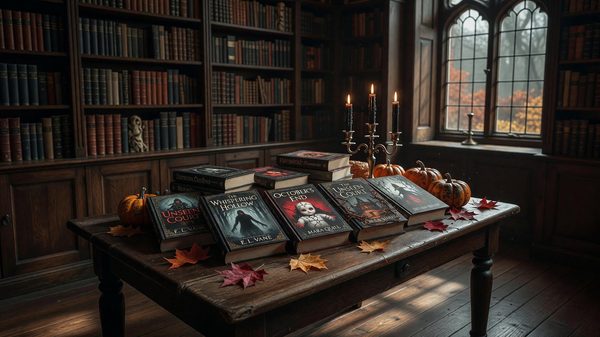
Gothic fiction is less a genre than a set of pressures: a house that knows too much, a family with a buried history, a narrator who cannot quite trust her own senses. October is when readers go looking for those pressures on purpose. The trick to a good gothic list is pairing, so that each classic sits next to a newer book that argues with it. Here is a plan, from the foundational titles to the Southern Gothic tradition and a handful of 2026 releases.
Start with the house: the classics
Rebecca
Daphne du Maurier’s Rebecca (1938) is still the cleanest entry point. An unnamed young narrator marries a wealthy widower and moves into Manderley, where the memory of his first wife shapes every room. It is a book about being measured against someone who is no longer there to defend herself, and it holds up because its menace is domestic and psychological rather than supernatural.
Jane Eyre and Wide Sargasso Sea
Charlotte Brontë’s Jane Eyre (1847) supplies the template: the remote house, the locked room, the secret that the household protects. Read it beside Jean Rhys’s Wide Sargasso Sea (1966), which gives a voice to the woman in the attic and turns the gothic inside out. The pairing is a lesson in how a later writer can interrogate an earlier one without cancelling it.
Shirley Jackson, two ways
The Haunting of Hill House (1959) and We Have Always Lived in the Castle (1962) are short enough to read in a weekend and unsettling enough to keep you up. Jackson understood that a haunting can be a symptom of a mind, a family or a town, and that the scariest thing in a gothic house is often the people who refuse to leave.
The Southern Gothic: a tradition with more than one lineage
The Southern Gothic is the American South’s version of the form, in which decay, inherited guilt and social hypocrisy do the haunting. The names most lists reach for first are William Faulkner, Flannery O’Connor and Carson McCullers, and each earns the place. But the tradition is wider than that canon, and a reviewer at Cemetery Dance has pointed out that Southern Gothic often elides the contributions of Black authors.
Two books fix that on your own shelf. Toni Morrison’s Beloved (1987) treats a haunting as the lasting presence of slavery rather than as a plot device. Jesmyn Ward’s Sing, Unburied, Sing (2017) sends a family on a road trip through Mississippi, with ghosts as part of the journey. Read either alongside O’Connor’s short stories and you can see how the same inherited-guilt machinery produces very different effects when the narrator is on the other side of the history.
Gothic in 2026: what to pair with the classics
Publishers have leaned into the gothic this autumn, and a few of the new releases pair naturally with the books above. Release dates vary by country, so check your local publisher’s listing before ordering.
- With Southern Gothic: On Sundays She Picked Flowers by Yah Yah Scholfield, a Southern Gothic horror debut published in January 2026, follows a woman who escapes her family home for the uncanny woods of northern Georgia. Pair it with Jackson for the shared theme of a family you cannot leave behind.
- With Dracula and the Victorian tradition: Elizabeth Kostova’s Mystery Play returns to the Dracula story that inspired her bestselling debut, The Historian. Its US publication date is listed as 13 October 2026; Australian listings give 3 November. In the novel, a man named Jay Turner inherits a Dracula-linked book and goes looking for an actor who played the count on stage. Pair it with any of the Victorian classics for a modern take on the same myth.
- With witchcraft and dark academia: Alice Hoffman’s The Witches of Cambridge, published by Scribner on 8 September 2026 according to retailer listings, belongs on a gothic shelf for its mix of history and the uncanny, though listings describe it as fantasy, so expect something warmer than Jackson.
- With Austen’s own gothic parody: A Bookshop.org list of fall 2026 gothic titles also names Nancy Bilyeau’s The Heiress of Northanger Abbey, a gothic-infused sequel to Austen, and Lauren Willig’s What Happens at Nightfall, a Brooklyn cemetery mystery. We have not confirmed release dates for either, so verify before you plan around them.
A note on tone: not every gothic book is a horror novel. Rebecca and Jane Eyre are romances shadowed by dread, Jackson is closer to psychological horror, and the Southern tradition often leans on dark comedy and moral reckoning. Knowing which register you want on a given night saves you from picking a book that is too bleak for a cozy evening or too gentle for a stormy one.
How to build your own October list
The easiest approach is to choose one house book, one Southern Gothic book and one 2026 release, and read them in that order. A suggested three: Rebecca, Beloved or Sing, Unburied, Sing, and the new title that appeals to you most. If you want shorter reads, Jackson’s two novels are the best value in the genre.
Pay attention to what each book does with its setting. In a good gothic, the house or the landscape is a character with its own motives, and comparing how Manderley, Hill House and the Georgia woods behave will tell you more about the form than any definition. Start with whichever one is already on your shelf, light the lamp, and let the weather do the rest.