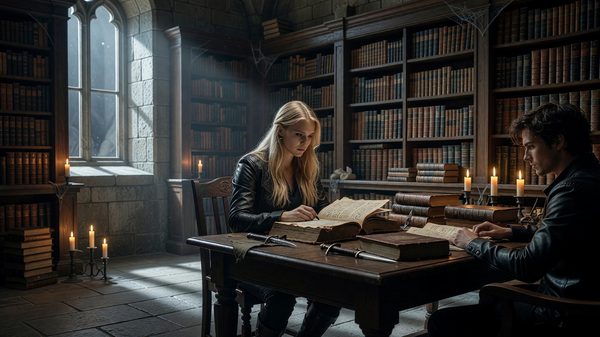
The middle volume of The Dark Artifices does what the best middle volumes do: it expands the world, deepens the characters, raises the stakes to a level the first book could not have sustained, and ends in a place that makes the wait for the finale feel genuinely difficult. Lord of Shadows is Clare’s most ambitious entry since City of Glass, and it earns that ambition.
Emma Carstairs and Julian Blackthorn are parabatai who are in love with each other, which is forbidden — parabatai who fall in love become a catastrophic magical force. That central tension drives the emotional engine of this book while the plot expands to include the London Shadowhunters, the Unseelie Court, and a threat to the Shadowhunter world that connects to the deepest history of the Accords.
The Parabatai Problem
Clare has been building to the consequences of Emma and Julian’s feelings across two books, and Lord of Shadows begins to show what those consequences look like when the bond is strained by love. The mythology around parabatai — what they share, what they can’t hide from each other, what happens when the bond is corrupted — gets significantly expanded here, and Clare uses it to create emotional tension that operates separately from the plot threats.
The London Shadowhunters
Cordelia Carstairs, James Herondale, and the characters who will anchor The Last Hours (the next Shadowhunter series, set a century earlier) appear here in ways that function as satisfying Easter eggs for long-term readers without requiring any knowledge of the other series to follow.
The Blackthorn Family
Julian remains one of Clare’s most morally complex protagonists. He loves his family with a devotion that has required him to make genuinely terrible choices, and this book pushes that further. What he is willing to do for the people he loves — and what that says about him — is the series’ central question.
Why YA Readers Will Love This
For readers who have been with the Shadowhunter world across multiple series: this book rewards that investment. The world has genuine depth by now, and Clare uses it with confidence.
For readers who love slow-burn romances built on genuine emotional obstacles rather than misunderstanding: Emma and Julian’s situation is one where the obstacle is structurally real and the emotional cost of it is felt throughout. The tension is sustainable because the stakes are clear.
For readers who love ensemble casts with distinct voices — the Blackthorn siblings are each fully realised characters, not background figures — this series is among the best in YA for managing a large family unit.
Queen of Air and Darkness concludes the trilogy and is worth the wait.
Published: May 2017 · Genre: YA fantasy · Series: The Dark Artifices, Book 2
Frequently Asked Questions
What does Lord of Shadows accomplish as the middle volume of The Dark Artifices? The review describes it as doing ‘what the best middle volumes do: expand the world, deepen the characters, raise the stakes to a level the first book could not have sustained, and end in a place that makes the wait for the finale feel genuinely difficult.’ It is called ‘Clare’s most ambitious entry since City of Glass.’ The expansion includes the London Shadowhunters, the Unseelie Court, and a threat tied to the deepest history of the Shadowhunter Accords.
How does the parabatai bond develop in Lord of Shadows? Clare begins showing the consequences of Emma and Julian’s feelings across two books, and the review notes that ‘Lord of Shadows begins to show what those consequences look like when the bond is strained by love.’ The mythology around parabatai — ‘what they share, what they can’t hide from each other, what happens when the bond is corrupted — gets significantly expanded, and Clare uses it to create emotional tension that operates separately from the plot threats.’ This parallel pressure track is what makes the book feel dense.
What role do the Last Hours characters play in Lord of Shadows? Cordelia Carstairs, James Herondale, and other characters who will anchor The Last Hours appear as ‘satisfying Easter eggs for long-term readers without requiring any knowledge of the other series to follow.’ The review positions these cameos as rewarding investment rather than gatekeeping — they add resonance for devoted readers while remaining transparent to those approaching Lord of Shadows without the broader context.
What makes Julian Blackthorn’s arc in Lord of Shadows compelling? Julian is described as ‘one of Clare’s most morally complex protagonists — he loves his family with a devotion that has required him to make genuinely terrible choices, and this book pushes that further.’ The review frames ‘what he is willing to do for the people he loves — and what that says about him’ as ’the series’ central question.’ The Blackthorn siblings are ’each fully realised characters, not background figures.’
Why does the forbidden romance between Emma and Julian sustain across the Dark Artifices? The review credits the obstacle with being ‘structurally real rather than based on misunderstanding — the emotional cost of it is felt throughout and the tension is sustainable because the stakes are clear.’ Readers who love slow-burn romances ‘built on genuine emotional obstacles rather than manufactured drama’ will find the Emma-Julian dynamic one of the most compelling in YA fantasy. The wait for the finale Queen of Air and Darkness is described as ‘worth it.’
Further Reading from Authoritative Sources
- Lord of Shadows — Wikipedia’s Lord of Shadows article provides publication details and series context, helping readers understand this second Dark Artifices instalment’s place within the Shadowhunter universe.
- Cassandra Clare — Wikipedia’s Cassandra Clare article provides biographical and bibliographical context for the author, helping readers understand Lord of Shadows within her extensive Shadowhunter universe and her approach to morally complex characters.